Compressed Air Has Water, Oil, and Odors – Is It the Wrong Air Compressor Filter Choice?
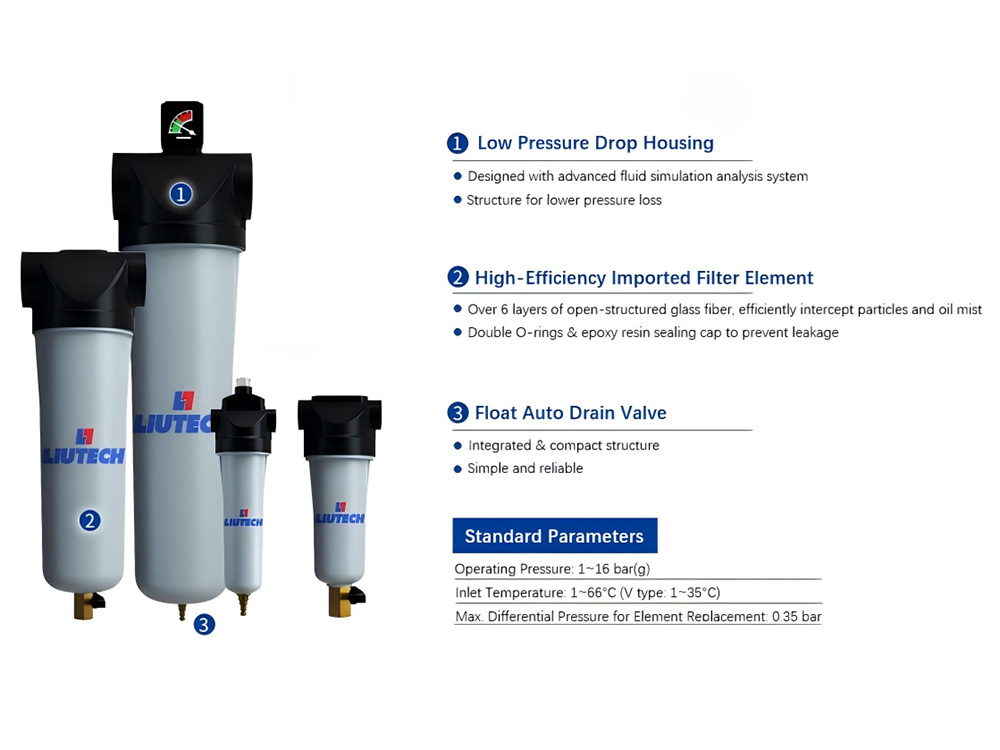
Customers often report compressed air issues in three common phrases: "There's water in the piping," "The air smells like oil," and "There's a strange odor at the point of use."
The usual first reaction is to “add a filter.” But field experience shows that filters are not a cureall. Excess water does not always mean the filter is not fine enough; an oil smell is not always solved by changing the filter element; and odors are even trickier – they may involve oil vapor, pipeline contamination, poor drainage, or incorrect downstream treatment sequencing.
Compressed air quality must be viewed as a system issue. The air compressor, air receiver, refrigerated or desiccant dryer, filters, piping, and condensate drains – each stage can affect the final air quality at the point of use.
This article breaks down the three most frequent customer complaints – water, oil, and odors – explaining where to check first and how to properly configure filters.
1. Water: Don't Blame the Filter First
Water in compressed air is the most common problem.
When air is compressed, its temperature rises; when it later cools, water vapor condenses into liquid water. If the compressor room has only the compressor itself, without a refrigerated dryer, desiccant dryer, air receiver drainage, or pipe drainage, water at the point of use is not surprising.
Filters can capture some liquid water and water mist, but they cannot replace a dryer. This is a critical concept.
For general applications – pneumatic cylinders, blow-off cleaning, packaging operations – a refrigerated dryer plus appropriate filters is often sufficient. For painting, laser cutting, food packaging, or electronics component blow-off, where dew point requirements are stricter, an adsorption (desiccant) dryer is often needed – relying solely on high-precision filters is not enough.
At Liutech, our engineers typically ask: Is a refrigerated dryer installed? Is its capacity adequate? Does the air receiver have an automatic drain? Are the filter bowl drains functioning? Are there low-point water traps in the piping? Do ambient temperature and air-use temperature fluctuate significantly?
If these basic issues are not addressed, upgrading to finer filters will have limited effect.
2. Oil: Distinguish Between Oil Mist and Oil Vapor
When customers say “there is oil” in compressed air, we need to distinguish two cases.
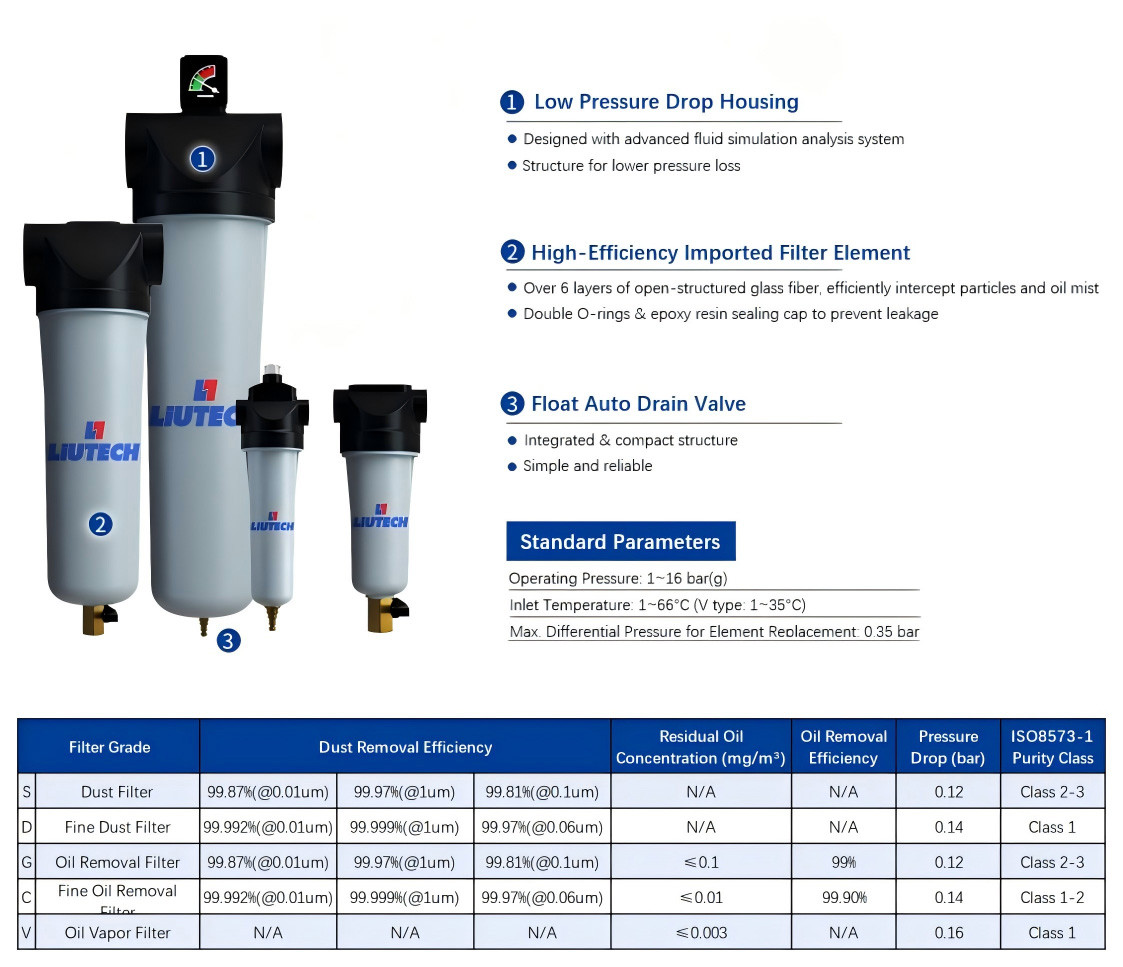
The first is oil mist or liquid oil droplets. This type of contaminant can be handled by coalescing filters. Coalescing filters work by causing fine oil and water aerosols to merge into larger droplets, which are then removed by gravity and discharged through drains.
The second is oil vapor or odor-causing molecules. These are no longer liquid droplets – ordinary precision filters have little effect. Activated carbon filters or higher-grade adsorption treatment are required.
This is a common point of confusion. If an oil smell is detected at the equipment, many assume the upstream precision filter has failed. In fact, the element may be intact – it was simply never designed to remove vapor.
For applications like painting, food contact, pharmaceutical packaging, or electronics cleaning, simply saying “install an oil-removal filter” is insufficient. You must consider whether a refrigerated dryer is present, whether pre-filtration is protecting the downstream filters, whether activated carbon is needed, and whether old oil residues remain in the piping.
3. Odors: The Problem Rarely Lies in a Single Element
Odors are the most worrying issue for customers.
Compressed air odors can come from lubricant vapor, or from the intake environment. For example, if the compressor intake is near paint solvents, chemicals, exhaust fumes, or dust, the compressor draws these gases in, putting heavy load on downstream filters.
Another cause is pipeline contamination. Old plant piping that has been in service for years may contain accumulated sludge, scale, and rust. Even with a new compressor and new filters, odors can persist at the point of use. In such cases, simply changing the element is not enough – you need to examine pipeline cleaning, air receiver drainage, filter arrangement, and end-use requirements.
Activated carbon filters help with odors and oil vapor, but they should normally be placed after pre-filtration and drying. If they face heavy water and oil mist loads upstream, the activated carbon will be quickly exhausted, shortening service life and reducing effectiveness.
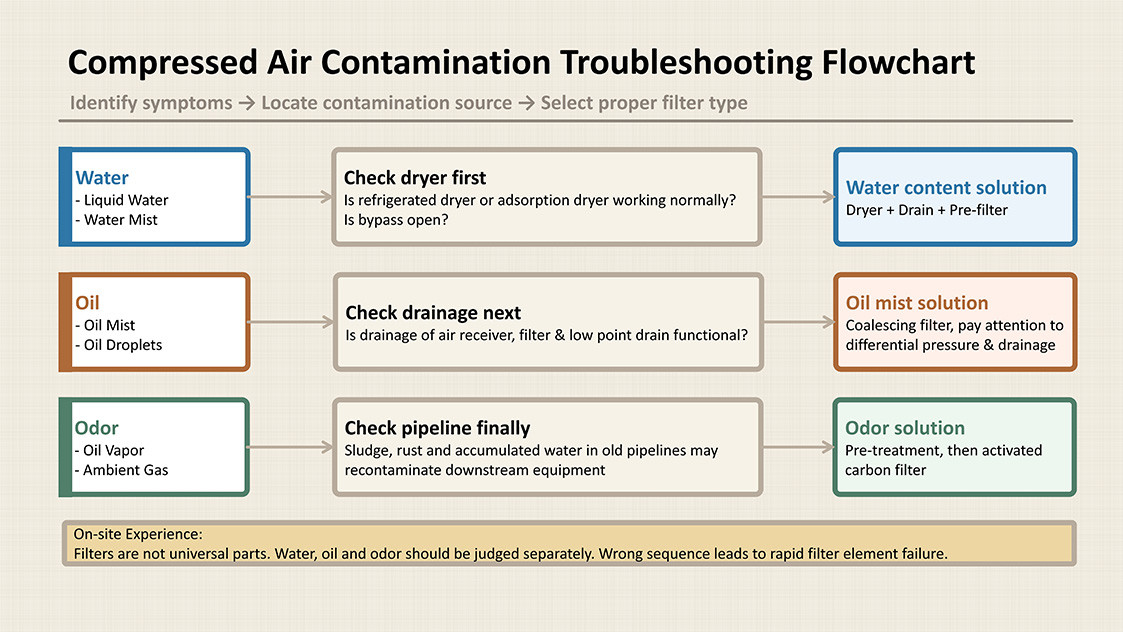
The diagram below provides a quick reference matching the three symptoms with common troubleshooting approaches.
4. Filters Are Not Always “Finer Is Better”
Many customers ask: “Should I just install the highestprecision filter available?”
We do not recommend that.
Higher-precision filters generally create higher pressure drop. If upstream protection is inadequate, the fine elements will soon become blocked by water, oil mist, and particulates. Once blocked, system pressure drop increases, outlet pressure drops, and the customer often raises the compressor discharge pressure – which in turn increases energy consumption.
Therefore, filter selection is about staging and sequence, not simply about micron rating.
The typical approach is: first remove bulk water and large particulates, then fine oil mist, and finally – depending on the application – address oil vapor and odors. For dew-point-sensitive applications, the dryer must be integrated into the overall system design.
Putting an activated carbon filter upstream where it is exposed to large volumes of water and oil mist is like using a fine screen to catch sand – the element will be rapidly depleted.
5. Different Applications Require Different Filtration Strategies
General pneumatic tools – mainly concerned with particulates and moisture. Focus on stable supply, reduced valve wear, and reliable condensate drainage.
Painting / coating – most sensitive to water and oil. Water in the air can cause pinholes or blushing; oil affects adhesion and surface finish. These applications typically require careful selection of refrigerated dryers, precision filters, and final-stage filtration.
Food & pharmaceutical – emphasize contamination risk. Beyond water, oil, and particulates, consider piping materials, sanitary drainage, filter maintenance records, and air quality validation.
Electronics – sensitive to particulates, moisture, and electrostatic conditions. Often a single filter is insufficient – dew point, cleanliness, and end-use handling must be addressed.
Laser cutting – requires stable air supply, adequate dryness, and minimal filter pressure drop to maintain cutting pressure. Contaminated air can affect optics, valves, and cut quality.
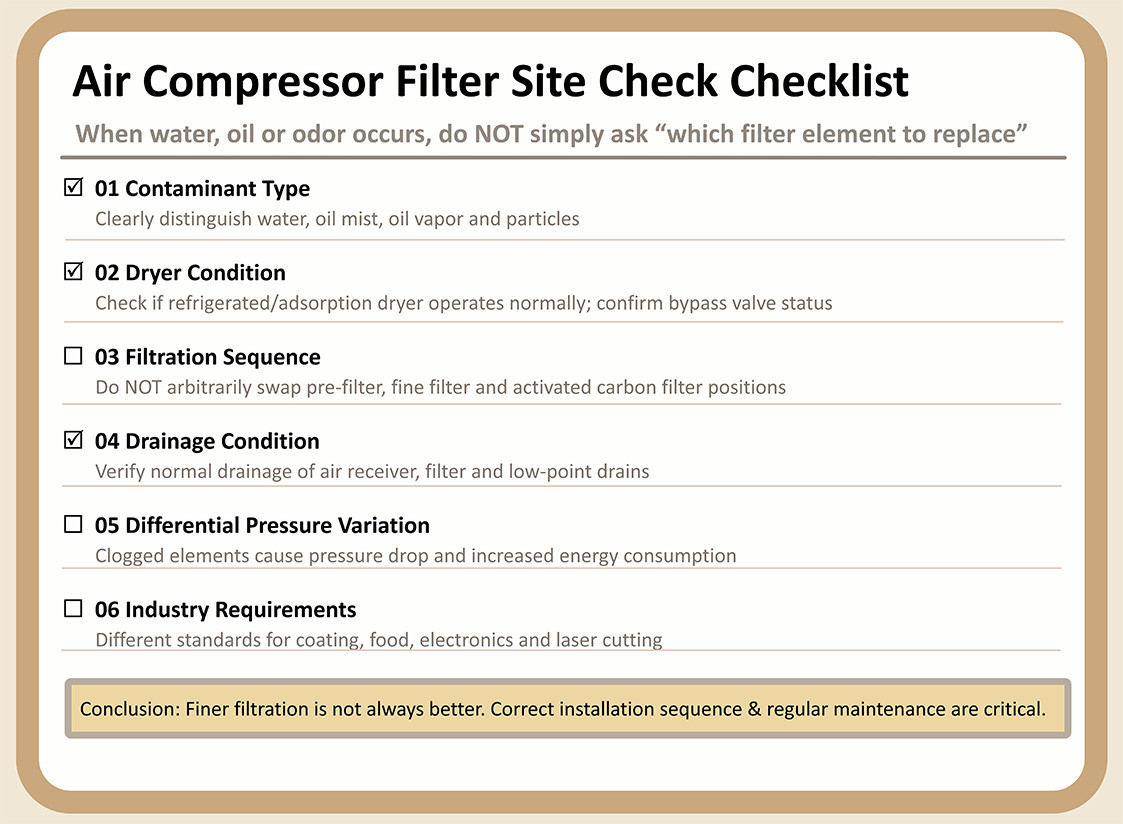
The checklist below can serve as an initial guide when assessing site conditions.
6. On-Site Troubleshooting Sequence
When a customer reports water, oil, or odors, we do not recommend quoting a replacement element as the first step. Instead, follow this sequence:
Check the compressor room environment – Is the intake near oil mist, solvents, dust, or hot air re-circulation?
Inspect the air receiver and drains – Standing water at the tank bottom and failed drains are a major source of moisture issues.
Check the dryer – Is the refrigerated dryer cooling properly? Is the desiccant dryer regenerating on schedule? Is the bypass valve inadvertently open?
Review filter staging – Are the pre-filter, precision filter, and activated carbon filter in the correct order? Are element change intervals overdue? Is the differential pressure gauge showing alarm?
Examine piping and end-use points – Is there sludge, rust, or low-point water in old piping? Are end-use hoses contaminated?
Only with this systematic approach can you determine whether the filter choice was wrong, or whether the overall downstream system configuration is incomplete.
At Liutech, when designing compressed air system solutions, we recommend evaluating the compressor, receiver, dryer, filters, and piping as an integrated whole. The compressor generates the air, the dryer controls moisture, the filters provide staged contaminant removal, and drainage and piping determine long-term stability.
Water, oil, and odors in compressed air are not always a matter of a single filter element. The reliable approach is to first identify the contaminant types, then stage the downstream treatment accordingly. This ensures the system stays clean not only right after installation, but also over the long term.
Related News
 Our CommitmentDec 19, 2025
 Compressed Air Has Water, Oil, and Odors – Is It the Wrong Air Compressor Filter Choice?Sep 02, 2026
 Introduction to Mobile Air Compressor VideoJan 14, 2025
 What the difference between Oil-Free and Oil-Injected Screw Compressors?Jan 14, 2025
 How Do Rotary Screw Air Compressors Work?Jan 14, 2025

Social Media
Ask For A Quick Quote
If you are looking for more information on our services, or how we could potentially help, we would love to hear from you!

High Standard
Superior Quality
High Standard
Superior Quality